What is a bank statement, and why keep it?
By Recofolio · Updated 20 Oct 2026 · 4 min readA bank statement is the bank's record of your account for a set period, usually a month: every line in and out, with an opening and a closing balance. Keep each one the day it arrives, because landlords, lenders, embassies and accountants ask for them, and a re-issued one takes days and usually costs a fee.

What a statement is
A bank statement is the bank's record of your account over a fixed period, usually a month. It lists every line: money in, money out, the date, and the words the bank used to describe it. It carries an opening balance at the top and a closing balance at the foot, and the lines between them add up to the difference. That is what makes it proof. Anyone can type a number into a spreadsheet; only the bank can print a statement.
How to read one
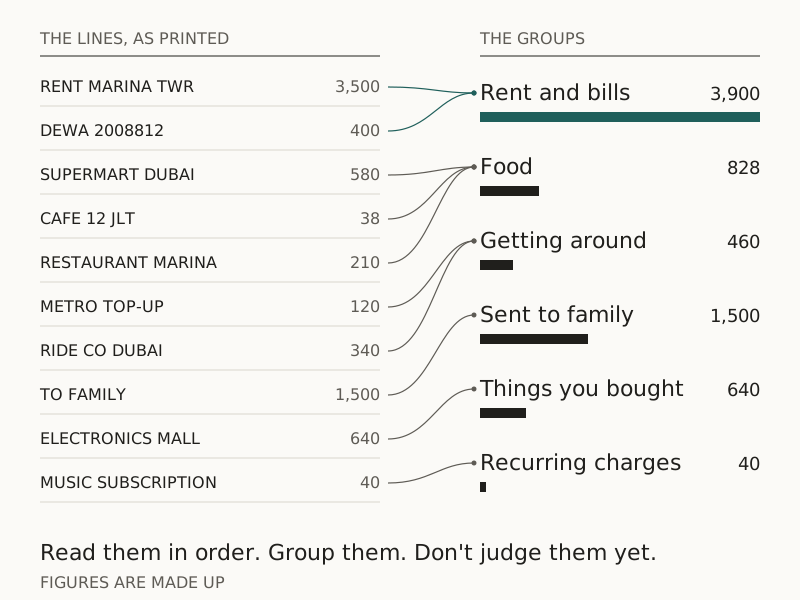
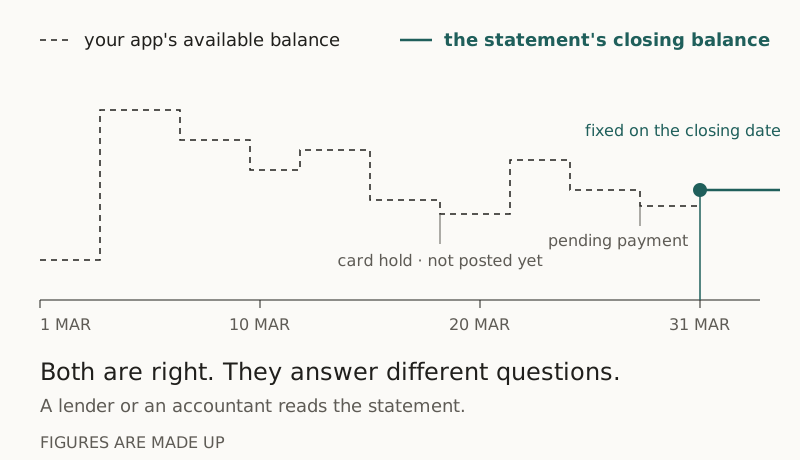
Read one from top to bottom once and the shape becomes familiar. The header names the account and the period. The opening balance is where the last statement left off. Each line has a date, the bank's description, an amount in or out, and often a running balance beside it. The closing balance is the figure the bank recorded on the last day of the period, after every line had posted. If you add the money in to the opening balance and take away the money out, you arrive at the closing balance. When you don't, a line is missing or counted twice.
When you'll need it
A tenancy contract, a loan or a card, a visa or a mortgage each ask for several months of statements, and your accountant asks for the year. Each of those moments arrives with a deadline. A statement your bank has to re-issue takes days, usually costs a fee, and sometimes comes back in a different format from the one you had. The one you saved the day it arrived is always the easiest to produce.
Why it outlasts the app
Statements also outlast the bank's own app. Apps change, accounts close, and the history in an app goes back only as far as the bank chooses to show. The PDF you saved is yours, in the form the bank printed it, for as long as you keep it.
What to do this month
Find the statement email, save the PDF to one folder, and name it by account and month. That is the whole habit. Recofolio reads the statements in that folder and turns them into one record, but the folder is worth keeping even if you never use anything else. Keep old statements for as long as you might be asked for them; how long that is depends on what they may be asked for, and your accountant can say.